
Author: Bwanika

  • How to Choose the Best Hotel Location for Sightseeing vs. Convenience

    How to Choose the Best Hotel Location for Sightseeing vs. Convenience

    There’s a decision every traveler faces usually at 11pm, eyes glazing over a sea of hotel listings that has quietly ruined more holidays than bad weather ever could.

    It’s not about the thread count or the breakfast buffet. It’s about location. More specifically: do you stay close to the sights you’ve been dreaming about, or do you plant yourself somewhere logistically clever and commute to the action?

    It sounds like a minor detail. It isn’t. Where you sleep shapes how you move through a city, how tired you feel by Thursday, and whether you actually get to that hidden courtyard you bookmarked six weeks ago. Get it right, and the whole trip flows.

    Get it wrong, and you’ll spend your mornings staring at a taxi queue, wondering why you thought saving £30 per night was worth the 40-minute bus ride into town.

    This is the guide to getting it right — every time.

    First, Know What Kind of Traveler You Actually Are

    Before you open a single booking site, spend two minutes answering one honest question: what does a great travel day look like for you?

    If you’re the type who wants to hit the ground running, squeeze five landmarks before noon, duck back to the room for a change of clothes, and be back out before the lunch crowds arrive you need a hotel that rewards proximity. Distance is your enemy.

    Every extra mile between you and the Colosseum, the Sagrada Família, or the Louvre is a buffer of friction inserted between you and the experience you came for.

    But if you’re a slower traveler someone who prefers to linger over a neighborhood coffee, follow whatever street looks interesting, and treat the journey as part of the destination a more residential, off-center location might actually serve you better.

    You’ll trade five-minute walks to tourist landmarks for the kind of atmospheric streets that don’t show up in itineraries.

    Neither approach is wrong. But conflating them — booking for one style while actually traveling in another — is where most hotel location mistakes are born.


    The Case for Staying Near the Sights

    Let’s say you’re visiting Rome for four days. The Colosseum, Vatican City, the Trevi Fountain, and the Pantheon are all on the list.

    You want to see them all, ideally without spending half your trip in transit. In this scenario, staying in the Centro Storico Rome’s historic center is not indulgent. It’s strategic.

    The math is simple. If your hotel sits within walking distance of three or four major attractions, you eliminate transport costs, queuing for taxis, and the cognitive load of constantly navigating an unfamiliar transit system.

    You can walk to the Pantheon in the morning before crowds arrive, return for a midday rest, then stroll to the Trevi Fountain in the cooler evening light. That rhythm explore, rest, explore again is only possible when your base is close to the action.

    There’s something else that proximity gives you: spontaneity. When you’re staying centrally, you don’t need a plan for every hour. You step outside and the city presents itself.

    You wander past a gallery, duck into a church, discover a market you hadn’t read about. Research consistently shows that proximity to attractions and walkability rank among the top priorities for leisure travelers and the reason isn’t just time-saving. It’s that closeness to a city’s core makes a trip feel alive in a way that a 30-minute commute from the suburbs simply doesn’t.

    And here’s a point that doesn’t get enough attention: when you stay centrally, you can travel lighter each day. No day pack stuffed with chargers and spare layers.

    No planning around transport schedules. You can nip back to the room. That alone the ability to reset mid-afternoon — reduces exhaustion and extends how long you can actually enjoy the day.


    The Case for Prioritizing Convenience Over Central Location

    Now flip the scenario. You’re traveling to a city for a week, you have a rental car, you’re planning a mix of day trips and city exploration, and you’re not interested in paying a premium to sleep 200 meters from Times Square.

    In that case, staying central might actively work against you. Hotels in the center of major cities tend to have limited parking, charge a fortune for it, and often sit on streets that are loud until 3am.

    If your itinerary takes you out of the city most days — to the coast, to wine country, to national parks — a slightly peripheral location near a motorway junction or train hub might serve you far better.

    Convenience also means different things depending on your specific trip. A hotel near a major transit hub a central rail station, an underground interchange, an airport can function as a superb base even without being geographically central to attractions.

    The key metric isn’t “how close am I to the main square?” It’s “how efficiently can I get from here to everywhere I want to go?”

    Consider London. Staying in Midtown or the West End makes obvious sense if you’re chasing museums, theaters, and famous landmarks.

    But if your trip involves multiple day excursions Windsor, Bath, Oxford staying near Paddington or King’s Cross might actually optimize your week better than anywhere central.

    Transport connectivity matters enormously, and a hotel a short walk from a major train station is a different kind of central than one squeezed between tourist restaurants.

    Budget is the other side of this argument. A well-located mid-range hotel on the periphery of a city center often offers the same structural advantages as a central luxury property but at a fraction of the price.

    Those savings compound across a week. Spend them on a great dinner or an experience you wouldn’t otherwise have afforded.


    The Triangle Method: A Framework That Actually Works

    One of the most practical approaches to hotel location comes from a method used by experienced travelers who have road-tested it across dozens of cities.

    The idea is simple: draw a triangle (or a circle, depending on how you think) between three anchor points your key attractions, your preferred transport links, and the everyday conveniences you rely on (supermarkets, pharmacies, good coffee). Your ideal hotel sits somewhere inside that shape.

    You don’t need to be at its geometric center. You just need to be within it. As one experienced travel writer describes it, the sweet spot is wherever everything you need is within easy reach without trekking too far in any direction.

    The beauty of this method is that it’s adaptable. Adjust the triangle for each trip, because your priorities change. A solo photography trip to Tokyo demands a different triangle than a family holiday to Barcelona.

    When applying this framework, be honest about your actual transport habits. Do you enjoy public transit as part of the experience, or does it stress you out? Are you fit and happy to walk 25 minutes to a restaurant, or would you rather be within a ten-minute radius of everything you need?

    The triangle won’t fail you — but it only works if you build it around who you actually are as a traveler, not who you think you should be.


    Noise, Safety, and the Hidden Costs of Central Living

    New York City sunset panorama with Manhattan skyline viewed from New Jersey.

    Here’s what the hotel comparison sites don’t tell you: central locations come with tradeoffs that don’t appear in the listing. The most obvious is noise. In cities like New York, Paris, Rome, and Bangkok, staying in the heart of the action means staying in the heart of the noise traffic, street vendors, late-night crowds, early-morning deliveries. If you sleep lightly, this is worth factoring in before you commit to that ideally situated property.

    Staying outside the city center — even by just a few kilometers — often means quieter streets, greener surroundings, and the kind of neighborhood calm that makes mornings genuinely restorative.

    Some travelers discover that the short commute into town becomes one of the more enjoyable parts of their trip, offering a slice of local daily life that tourist zones never provide.

    Safety perception is another variable. In major tourist centers, elevated foot traffic and the density of visitors creates certain risks pickpocketing, scams, and the kind of aggressive touts that tend to cluster around heavily trafficked landmarks.

    These aren’t reasons to avoid central areas, but they’re worth factoring into your comfort equation, particularly if you’re traveling alone or with children.


    City-Specific Thinking: One Size Never Fits All

    The sightseeing-versus-convenience question looks completely different depending on which city you’re visiting. Here’s how to approach a few of the world’s most popular destinations.

    New York City: For first-time visitors, Midtown Manhattan delivers everything proximity to iconic landmarks, density of food options, and subway connections that fan out across the city. The downside is price and the tourist-trap density of the immediate area.

    Experienced visitors often prefer Chelsea or the Flatiron District: still well-connected, with a more authentic neighborhood character and slightly less aggressive pricing.

    Rome: The Centro Storico is hard to beat for first-timers who want to see the classical highlights in an itinerary-efficient way.

    For a second visit, the Trastevere neighborhood offers a livelier, more atmospheric stay — though you’ll accept some distance from the major monuments in exchange for genuine local character.

    San Francisco: The city’s compact layout and comprehensive public transit mean that location selection is more forgiving than in sprawling cities like Los Angeles. Union Square is central and well-connected but lacks charm.

    Neighborhoods like the Mission, Hayes Valley, or even Fisherman’s Wharf offer more defined experiences depending on whether you’re chasing culture, food, or waterfront atmosphere.

    London: The city is large enough that your choice of base seriously affects your daily experience.

    For pure sightseeing efficiency, South Bank gives you proximity to cultural institutions on both sides of the Thames. For a more local feel with solid transport connections, Islington around Angel offers the kind of neighborhood texture that central tourist areas rarely achieve.


    How to Actually Research Your Hotel Location (Before You Book)

    Reading reviews is necessary but insufficient. Most hotel reviews speak to the quality of the room, the staff, and the breakfast — not to the strategic value of the location for your specific itinerary.

    Here’s a more rigorous approach. Before committing to a property, open Google Maps and time the walk from the hotel to your three most important destinations. Not the distance the walking time, accounting for how the streets actually run. Then check the nearest public transit stops and confirm frequency.

    Booking.com’s map view lets you cross-reference price, location, and rating simultaneously, which makes the trade-offs far more visible than a list view ever does.

    Read the most recent reviews specifically for location-related comments. Previous guests will often mention whether street noise was an issue, whether the area felt safe at night, and whether the hotel’s described proximity to attractions was accurate.

    Pay attention to reviews from travelers with similar itineraries to yours — a solo photographer’s experience of a neighborhood will differ wildly from that of a family with young children.


    The Budget Question: Does Centrality Always Cost More?

    Not necessarily. This is one of the more persistent myths in travel planning. Yes, a suite at a five-star property overlooking the Eiffel Tower will cost significantly more than a similarly appointed room in a quieter arrondissement.

    But at the mid-range and budget end of the market, the price gap between central and peripheral accommodation is often far smaller than travelers assume particularly when you factor in what you’d spend on transport from a cheaper, out-of-the-way option.

    Budget travelers can absolutely stay close to the action without spending a fortune. Budget hotel chains, boutique hostels, and independent guesthouses in central neighborhoods frequently offer competitive rates, especially if booked directly through the property rather than through third-party platforms.

    The key is to search with specific neighborhood filters rather than sorting purely by price — which tends to surface the cheapest rooms regardless of where they are.


    Making the Final Call

    When the research is done and the options are narrowed, the decision usually comes down to a single, clear-eyed question: what will make this trip feel most like the trip you planned to take?

    If you’ll spend most of your time at specific landmarks, choose the hotel that gives you walking access to them even if it costs a little more.

    The value of being able to step outside, turn left, and be at the museum in eight minutes is not captured by a per-night price comparison.

    If your trip is about atmosphere, flexibility, and exploring a city rather than checking off monuments, find the neighborhood that reflects the version of the destination you came to see and stay there, even if it means accepting a transit commute to the tourist landmarks.

    And if you’re unsure — which is more common than either option use the triangle method. Draw the shape around your priorities, find the sweet spot, and let the city organize itself around you.


    Which matters more to you when choosing a hotel being within walking distance of the main sights, or having practical convenience and great transport links? Share your approach in the comments below.
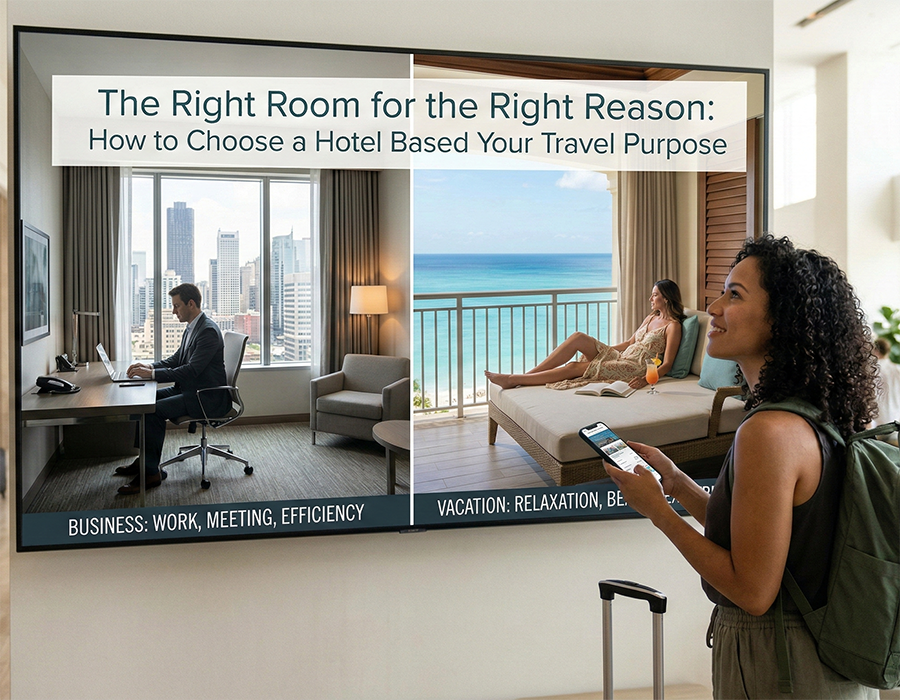

  • The Right Room for the Right Reason: How to Choose a Hotel Based on Your Travel Purpose

    The Right Room for the Right Reason: How to Choose a Hotel Based on Your Travel Purpose

    There’s a certain art to choosing a hotel. Not the kind that involves endlessly scrolling through booking platforms at midnight, toggling between star ratings and squinting at tiny room photos the kind that comes from knowing, with genuine clarity, what you actually need from a stay.

    A road warrior gunning for a 7 AM board meeting requires something entirely different from a couple celebrating an anniversary, a PhD student pulling research weeks, or a family road-tripping across the country.

    Yet most travelers approach the booking process the same way every time: find something decent, check the price, hit confirm.

    That approach works, right up until it doesn’t. Until the business traveler finds themselves in a resort hotel with no desk, no fast Wi-Fi, and a lobby full of children wearing floaties.

    Or the vacationer lands in a sterile corporate tower surrounded by conference rooms and zero soul. The mismatch between travel purpose and hotel selection is one of the most preventable travel mistakes and one of the most common.

    This guide breaks it down by purpose. Whether you’re heading out for work, leisure, a major life event, or an extended study stint, here’s how to make the hotel work for you, not against you.


    Why Travel Purpose Should Drive Every Booking Decision

    Before you filter by price, before you look at photos, you need to answer one question honestly: Why am I going?

    The answer changes everything. According to Booking.com for Business, identifying the purpose of the trip whether it’s visiting clients, attending a convention, or working from a remote location is the single most important first step before evaluating any hotel.

    Location preferences, room requirements, amenity priorities, and even check-in flexibility all shift dramatically depending on your reason for traveling.

    Think of it this way: a hotel is essentially a temporary version of your life. If your life at that moment is high-performance and deadline-driven, your hotel needs to match that energy.

    If your life at that moment is finally exhaling after months of stress, your hotel should support that exhale. The building is the same. The purpose and therefore the ideal choice is completely different.


    Traveling for Business: Precision Over Prestige

    Business travel is transactional by nature. You’re not there to marvel at the view. You’re there to show up, perform, and ideally not lose a night of sleep over a noisy HVAC unit or missing outlet.

    With 40% of hotel guests being business travelers, the market for corporate-friendly accommodation is large but that doesn’t mean every hotel in the mix actually delivers what a working professional needs.

    Location is non-negotiable. The ideal business hotel sits close to your meeting venues, client offices, or convention center — not just close to the airport. Every extra minute in transit is a minute of productivity lost, and the cognitive tax of navigating an unfamiliar city when you’re already jet-lagged is real.

    The key factor in finding hotels for work trips remains proximity to the areas the business trip centers around, and that means doing more than checking the city name on the listing.

    Workspace quality matters more than room size. A business traveler needs a proper desk with good lighting, reliable power outlets, USB ports, and genuinely fast Wi-Fi — not the kind that technically works but buffers during a video call.

    Hotels targeting corporate travelers increasingly invest in workspaces throughout the property, including meeting rooms available for guest use. If these aren’t listed in the amenities, ask directly before booking.

    Flexibility in booking terms protects you. Corporate schedules shift. Meetings run over. Projects stall. A hotel with rigid cancellation policies or no option to modify your stay last-minute becomes a liability when your itinerary inevitably changes. Look for properties with generous cancellation windows and responsive front desk teams.

    Wellness is part of productivity. Nearly half of workplace travelers now factor physical health into their accommodation decisions, which means the gym, the quality of on-site dining, and even access to outdoor space have moved from nice-to-have to operational necessity for many road warriors.

    A hotel that lets you maintain your routine a morning run, a decent breakfast, a proper sleep environment will consistently outperform one that merely checks the corporate rate box.

    Loyalty programs earn their keep here. For frequent business travelers, selecting a hotel chain with a strong loyalty program can translate into meaningful perks over time.

    The Points Guy’s breakdown of hotel chains for business travelers notes that Hyatt Globalist status offers some of the most tangible benefits for road warriors, while Marriott’s broad footprint makes it a reliable fallback in almost any business destination.


    Traveling for Vacation: Atmosphere, Access, and the Right Kind of Nothing

    A vacation hotel has one job: to make you feel like you’re somewhere worth being. That’s a deceptively broad brief, and it’s where most travelers either nail it or completely miss the mark by defaulting to generic bookings that could have been made with their eyes closed.

    Start with the vibe. This sounds imprecise, but Hotels.com data from Expedia Group’s Unpack ’24 report found that guest reviews mentioning the word “vibe” increased an extraordinary 1,090% year-over-year meaning travelers are genuinely making decisions based on atmosphere and feeling, not just star ratings and pool dimensions.

    Before you book, ask yourself what kind of experience you want to step into. A boutique hotel in a residential neighborhood gives you something fundamentally different from a sprawling beach resort, even if both are technically “four stars.”

    Match the hotel’s location to your vacation style. If you’re the type who wants to spend every morning at the local market and evenings at neighborhood restaurants, stay somewhere embedded in the city fabric walkable, residential, close to the texture of daily life. If you’d rather surrender entirely to property amenities — spa, beach, curated activities, multiple dining options a self-contained resort makes more sense.

    AAA Travel’s guidance on lodging selection makes an important point: you don’t always need to be in the center of things to get great value. Sometimes the best vacation hotel is slightly off the beaten path, offering proximity to what you actually want without the noise and markup of the prime location.

    Read recent reviews with surgical intent. A hotel that was exceptional three years ago may have changed ownership, cut staff, or let maintenance slide.

    The Travel’s guide to hotel selection recommends giving preference to the most recent reviews, as they’re the most relevant to your current stay.

    Look specifically at reviews from guests who traveled in a similar style to yours couples, families, solo travelers because what irritates a solo backpacker may be completely irrelevant to a couple celebrating an anniversary.

    Think about what you actually need, not what sounds impressive. Free parking is irrelevant if you’re not driving. Pet-friendly policies mean nothing if you’re not bringing an animal. But free breakfast? That’s a concrete financial benefit that compounds across a multi-day stay.

    A complimentary breakfast can meaningfully reduce daily spend while taking one decision entirely off the morning agenda.

    Consider wellness offerings if rest is the point. The hospitality industry has been investing heavily in wellness amenities in recent years on-site spas, meditation spaces, alcohol-free beverage options, nature access responding to travelers who want their vacations to actually restore them rather than simply relocate them.

    If recovery is your goal, seek out properties that have made wellness a genuine part of their offering.


    Traveling for an Event: Logistics Win Every Time

    Weddings, conferences, concerts, galas, family reunions — event travel has a specific gravity of its own. The hotel becomes less of a resting place and more of a logistical hub. And when things go wrong with event logistics, they tend to go wrong hard.

    Proximity to the venue is the top priority, full stop. When you’re dressed for a black-tie event, the last thing you want is a fifteen-minute taxi ride through unpredictable traffic.

    When the wedding reception runs until midnight and the ceremony is at 10 AM the next day, being close enough to walk back is worth nearly any price premium.

    Proximity to the event venue should be treated as a hard filter, not a preference.

    Group booking policies require close attention. If you’re part of a group attending the same event, check whether the hotel offers group rates, blocked room allocations, or coordinated check-in processes.

    Many conference hotels maintain room blocks specifically for attendees — these are sometimes the most cost-effective option and come with the built-in benefit of proximity and familiarity with the event’s schedule.

    Flexibility on checkout timing matters. Events often have odd scheduling rhythms. If the final ceremony or gala runs late into the night, you want a hotel that either offers late checkout or, at minimum, has secure luggage storage so you’re not scrambling before a flight. Ask about this specifically before booking.

    Noise tolerance is worth considering. Hotels hosting their own events conferences, weddings, corporate dinners can get loud, particularly on lower floors near function spaces.

    If you’re attending a demanding event and need proper rest, pay attention to room placement. Request upper floors away from ballrooms if the hotel serves as both your accommodation and a venue for others.


    Traveling for Study or Extended Academic Stays

    travelling_for_academics

    This category doesn’t get nearly enough coverage in hotel guides, but it’s increasingly common researchers attending academic conferences, visiting scholars, graduate students on field research, professionals completing certification programs.

    Extended study travel has a distinct set of requirements that neither the business traveler’s brief nor the vacation traveler’s brief fully captures.

    Duration changes the math entirely. For stays of a week or more, the economics and comfort calculus of hotel selection shift significantly.

    Serviced apartments and extended-stay properties offer the kind of home-like environment kitchen access, separate living areas, laundry facilities that becomes genuinely important when you’re not just sleeping somewhere but actually living and working there for weeks.

    Many booking platforms now offer both traditional hotel options and apartment-style accommodations side by side; don’t default to a standard room if an apartment-style unit is available at a comparable price.

    Quiet and concentration are non-negotiable. A study stay demands actual cognitive quiet both acoustically and in terms of the property’s general atmosphere.

    High-energy resort properties, event-heavy conference hotels, and tourist-facing boutique spots can all be disruptive for someone trying to process research, write, or study consistently.

    Look for properties in quieter neighborhoods, and specifically check reviews for noise levels and the general guest demographic.

    Library and study access matters. If you’re stationed near a university or research institution, the hotel’s proximity to that facility and to cafés, libraries, and coworking spaces matters as much as the room itself.

    Some forward-thinking hotel properties now offer dedicated study lounges or desk-sharing arrangements with nearby coworking spaces, a practical amenity that’s worth actively seeking out.

    Meal planning is part of the equation. Eating out every day for an extended stay is both expensive and cognitively tiring.

    A room with even basic kitchen facilities a microwave, a mini fridge, the ability to store groceries can dramatically improve the quality of a long study stay.

    This is one area where an apartment-style booking often beats a traditional hotel room outright.

    The Cross-Cutting Rules That Apply to Every Travel Purpose

    Regardless of why you’re going, a few principles hold across the board.

    Read reviews strategically, not impressionistically. Don’t just look at the star average. Look at the breakdown what percentage of reviews are one and two stars, and what do they complain about?

    A pattern of complaints about noise, cleanliness, or unresponsive staff is more predictive of your experience than a high overall average padded by complimentary-room reviewers.

    Price and value are not the same thing. The Travel’s hotel selection guide makes the important observation that more expensive accommodation isn’t always better it might be expensive because of the view, the location, the brand name, or other factors that may or may not matter to you.

    The right question is never “is this cheap?” or “is this expensive?” but rather “does this price reflect the value I’ll actually receive for this specific trip?”

    Loyalty programs are a long game worth playing. Whether you’re a frequent business traveler or someone who takes two or three vacations a year, aligning your bookings with a single hotel loyalty program builds equity over time suite upgrades, free nights, priority check-in, and the kind of consistent experience that removes friction from the process entirely.

    The Points Guy’s analysis of major hotel chains notes that Hyatt Globalist members can expect suite upgrades on nearly 90% of leisure stays, which represents a substantial tangible benefit for anyone willing to concentrate their bookings.

    Sustainability is increasingly a legitimate selection criterion. As major corporations recognize that business travel can account for more than half of a company’s total carbon footprint, hotel sustainability credentials have moved from marketing language to operational reality.

    Many hotels now publish clear commitments around energy use, waste reduction, and local sourcing — and for travelers who care about this, those commitments are worth verifying.


    The Final Question Before You Book

    Here’s the filter that cuts through all the noise: if this hotel stay goes exactly as planned the check-in is smooth, the room is as described, the amenities work as advertised will it actively support the reason you’re traveling?

    Not just fail to hinder it. Actually support it.

    For the business traveler, that means the workspace enables focus, the location cuts commute time, and the service model respects that you’re there to work.

    For the vacationer, it means the atmosphere matches the mood you traveled to find.

    For the event traveler, it means the logistics hold together without drama. For the student or researcher, it means the environment sustains concentration over the long haul.

    That question does this hotel actively serve my purpose? is the one most travelers never ask.

    Ask it every time, and the booking process gets considerably simpler, and considerably smarter.

    Where are you headed next? Drop your destination and purpose in the comments we’d love to help you figure out which type of property makes the most sense for your trip.


    Looking for more travel planning guidance? Explore our other guides on maximizing hotel loyalty programs, navigating business travel accommodation options, and finding the best hotel amenities for your traveler type.