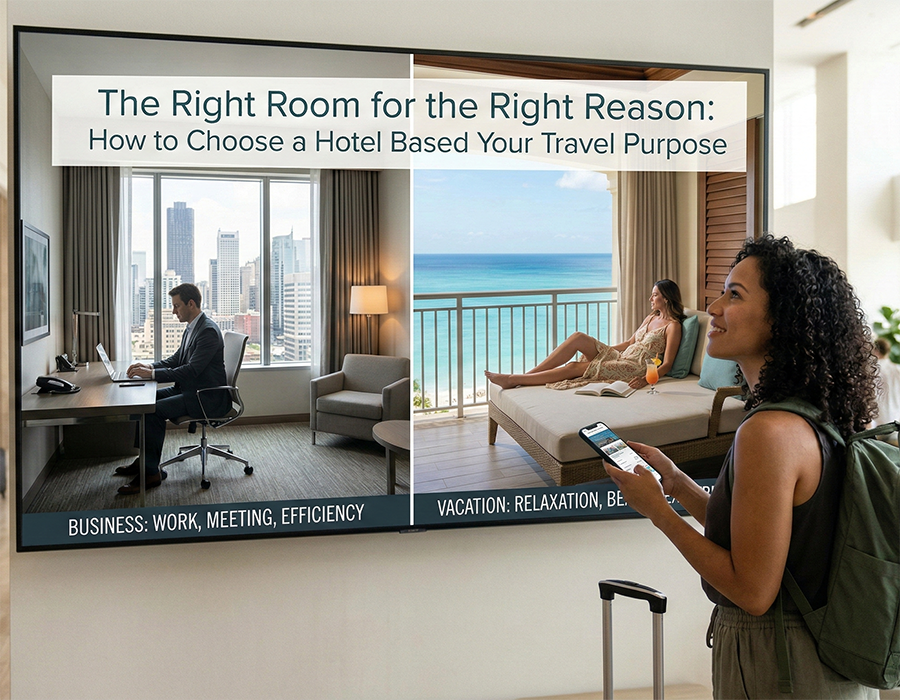
There’s a certain art to choosing a hotel. Not the kind that involves endlessly scrolling through booking platforms at midnight, toggling between star ratings and squinting at tiny room photos the kind that comes from knowing, with genuine clarity, what you actually need from a stay.
A road warrior gunning for a 7 AM board meeting requires something entirely different from a couple celebrating an anniversary, a PhD student pulling research weeks, or a family road-tripping across the country.
Yet most travelers approach the booking process the same way every time: find something decent, check the price, hit confirm.
That approach works, right up until it doesn’t. Until the business traveler finds themselves in a resort hotel with no desk, no fast Wi-Fi, and a lobby full of children wearing floaties.
Or the vacationer lands in a sterile corporate tower surrounded by conference rooms and zero soul. The mismatch between travel purpose and hotel selection is one of the most preventable travel mistakes and one of the most common.
This guide breaks it down by purpose. Whether you’re heading out for work, leisure, a major life event, or an extended study stint, here’s how to make the hotel work for you, not against you.
Why Travel Purpose Should Drive Every Booking Decision
Before you filter by price, before you look at photos, you need to answer one question honestly: Why am I going?
The answer changes everything. According to Booking.com for Business, identifying the purpose of the trip whether it’s visiting clients, attending a convention, or working from a remote location is the single most important first step before evaluating any hotel.
Location preferences, room requirements, amenity priorities, and even check-in flexibility all shift dramatically depending on your reason for traveling.
Think of it this way: a hotel is essentially a temporary version of your life. If your life at that moment is high-performance and deadline-driven, your hotel needs to match that energy.
If your life at that moment is finally exhaling after months of stress, your hotel should support that exhale. The building is the same. The purpose and therefore the ideal choice is completely different.
Traveling for Business: Precision Over Prestige

Business travel is transactional by nature. You’re not there to marvel at the view. You’re there to show up, perform, and ideally not lose a night of sleep over a noisy HVAC unit or missing outlet.
With 40% of hotel guests being business travelers, the market for corporate-friendly accommodation is large but that doesn’t mean every hotel in the mix actually delivers what a working professional needs.
Location is non-negotiable. The ideal business hotel sits close to your meeting venues, client offices, or convention center — not just close to the airport. Every extra minute in transit is a minute of productivity lost, and the cognitive tax of navigating an unfamiliar city when you’re already jet-lagged is real.
The key factor in finding hotels for work trips remains proximity to the areas the business trip centers around, and that means doing more than checking the city name on the listing.
Workspace quality matters more than room size. A business traveler needs a proper desk with good lighting, reliable power outlets, USB ports, and genuinely fast Wi-Fi — not the kind that technically works but buffers during a video call.
Hotels targeting corporate travelers increasingly invest in workspaces throughout the property, including meeting rooms available for guest use. If these aren’t listed in the amenities, ask directly before booking.
Flexibility in booking terms protects you. Corporate schedules shift. Meetings run over. Projects stall. A hotel with rigid cancellation policies or no option to modify your stay last-minute becomes a liability when your itinerary inevitably changes. Look for properties with generous cancellation windows and responsive front desk teams.
Wellness is part of productivity. Nearly half of workplace travelers now factor physical health into their accommodation decisions, which means the gym, the quality of on-site dining, and even access to outdoor space have moved from nice-to-have to operational necessity for many road warriors.
A hotel that lets you maintain your routine a morning run, a decent breakfast, a proper sleep environment will consistently outperform one that merely checks the corporate rate box.
Loyalty programs earn their keep here. For frequent business travelers, selecting a hotel chain with a strong loyalty program can translate into meaningful perks over time.
The Points Guy’s breakdown of hotel chains for business travelers notes that Hyatt Globalist status offers some of the most tangible benefits for road warriors, while Marriott’s broad footprint makes it a reliable fallback in almost any business destination.
Traveling for Vacation: Atmosphere, Access, and the Right Kind of Nothing

A vacation hotel has one job: to make you feel like you’re somewhere worth being. That’s a deceptively broad brief, and it’s where most travelers either nail it or completely miss the mark by defaulting to generic bookings that could have been made with their eyes closed.
Start with the vibe. This sounds imprecise, but Hotels.com data from Expedia Group’s Unpack ’24 report found that guest reviews mentioning the word “vibe” increased an extraordinary 1,090% year-over-year meaning travelers are genuinely making decisions based on atmosphere and feeling, not just star ratings and pool dimensions.
Before you book, ask yourself what kind of experience you want to step into. A boutique hotel in a residential neighborhood gives you something fundamentally different from a sprawling beach resort, even if both are technically “four stars.”
Match the hotel’s location to your vacation style. If you’re the type who wants to spend every morning at the local market and evenings at neighborhood restaurants, stay somewhere embedded in the city fabric walkable, residential, close to the texture of daily life. If you’d rather surrender entirely to property amenities — spa, beach, curated activities, multiple dining options a self-contained resort makes more sense.
AAA Travel’s guidance on lodging selection makes an important point: you don’t always need to be in the center of things to get great value. Sometimes the best vacation hotel is slightly off the beaten path, offering proximity to what you actually want without the noise and markup of the prime location.
Read recent reviews with surgical intent. A hotel that was exceptional three years ago may have changed ownership, cut staff, or let maintenance slide.
The Travel’s guide to hotel selection recommends giving preference to the most recent reviews, as they’re the most relevant to your current stay.
Look specifically at reviews from guests who traveled in a similar style to yours couples, families, solo travelers because what irritates a solo backpacker may be completely irrelevant to a couple celebrating an anniversary.
Think about what you actually need, not what sounds impressive. Free parking is irrelevant if you’re not driving. Pet-friendly policies mean nothing if you’re not bringing an animal. But free breakfast? That’s a concrete financial benefit that compounds across a multi-day stay.
A complimentary breakfast can meaningfully reduce daily spend while taking one decision entirely off the morning agenda.
Consider wellness offerings if rest is the point. The hospitality industry has been investing heavily in wellness amenities in recent years on-site spas, meditation spaces, alcohol-free beverage options, nature access responding to travelers who want their vacations to actually restore them rather than simply relocate them.
If recovery is your goal, seek out properties that have made wellness a genuine part of their offering.
Traveling for an Event: Logistics Win Every Time

Weddings, conferences, concerts, galas, family reunions — event travel has a specific gravity of its own. The hotel becomes less of a resting place and more of a logistical hub. And when things go wrong with event logistics, they tend to go wrong hard.
Proximity to the venue is the top priority, full stop. When you’re dressed for a black-tie event, the last thing you want is a fifteen-minute taxi ride through unpredictable traffic.
When the wedding reception runs until midnight and the ceremony is at 10 AM the next day, being close enough to walk back is worth nearly any price premium.
Proximity to the event venue should be treated as a hard filter, not a preference.
Group booking policies require close attention. If you’re part of a group attending the same event, check whether the hotel offers group rates, blocked room allocations, or coordinated check-in processes.
Many conference hotels maintain room blocks specifically for attendees — these are sometimes the most cost-effective option and come with the built-in benefit of proximity and familiarity with the event’s schedule.
Flexibility on checkout timing matters. Events often have odd scheduling rhythms. If the final ceremony or gala runs late into the night, you want a hotel that either offers late checkout or, at minimum, has secure luggage storage so you’re not scrambling before a flight. Ask about this specifically before booking.
Noise tolerance is worth considering. Hotels hosting their own events conferences, weddings, corporate dinners can get loud, particularly on lower floors near function spaces.
If you’re attending a demanding event and need proper rest, pay attention to room placement. Request upper floors away from ballrooms if the hotel serves as both your accommodation and a venue for others.
Traveling for Study or Extended Academic Stays

This category doesn’t get nearly enough coverage in hotel guides, but it’s increasingly common researchers attending academic conferences, visiting scholars, graduate students on field research, professionals completing certification programs.
Extended study travel has a distinct set of requirements that neither the business traveler’s brief nor the vacation traveler’s brief fully captures.
Duration changes the math entirely. For stays of a week or more, the economics and comfort calculus of hotel selection shift significantly.
Serviced apartments and extended-stay properties offer the kind of home-like environment kitchen access, separate living areas, laundry facilities that becomes genuinely important when you’re not just sleeping somewhere but actually living and working there for weeks.
Many booking platforms now offer both traditional hotel options and apartment-style accommodations side by side; don’t default to a standard room if an apartment-style unit is available at a comparable price.
Quiet and concentration are non-negotiable. A study stay demands actual cognitive quiet both acoustically and in terms of the property’s general atmosphere.
High-energy resort properties, event-heavy conference hotels, and tourist-facing boutique spots can all be disruptive for someone trying to process research, write, or study consistently.
Look for properties in quieter neighborhoods, and specifically check reviews for noise levels and the general guest demographic.
Library and study access matters. If you’re stationed near a university or research institution, the hotel’s proximity to that facility and to cafés, libraries, and coworking spaces matters as much as the room itself.
Some forward-thinking hotel properties now offer dedicated study lounges or desk-sharing arrangements with nearby coworking spaces, a practical amenity that’s worth actively seeking out.
Meal planning is part of the equation. Eating out every day for an extended stay is both expensive and cognitively tiring.
A room with even basic kitchen facilities a microwave, a mini fridge, the ability to store groceries can dramatically improve the quality of a long study stay.
This is one area where an apartment-style booking often beats a traditional hotel room outright.
The Cross-Cutting Rules That Apply to Every Travel Purpose
Regardless of why you’re going, a few principles hold across the board.
Read reviews strategically, not impressionistically. Don’t just look at the star average. Look at the breakdown what percentage of reviews are one and two stars, and what do they complain about?
A pattern of complaints about noise, cleanliness, or unresponsive staff is more predictive of your experience than a high overall average padded by complimentary-room reviewers.
Price and value are not the same thing. The Travel’s hotel selection guide makes the important observation that more expensive accommodation isn’t always better it might be expensive because of the view, the location, the brand name, or other factors that may or may not matter to you.
The right question is never “is this cheap?” or “is this expensive?” but rather “does this price reflect the value I’ll actually receive for this specific trip?”
Loyalty programs are a long game worth playing. Whether you’re a frequent business traveler or someone who takes two or three vacations a year, aligning your bookings with a single hotel loyalty program builds equity over time suite upgrades, free nights, priority check-in, and the kind of consistent experience that removes friction from the process entirely.
The Points Guy’s analysis of major hotel chains notes that Hyatt Globalist members can expect suite upgrades on nearly 90% of leisure stays, which represents a substantial tangible benefit for anyone willing to concentrate their bookings.
Sustainability is increasingly a legitimate selection criterion. As major corporations recognize that business travel can account for more than half of a company’s total carbon footprint, hotel sustainability credentials have moved from marketing language to operational reality.
Many hotels now publish clear commitments around energy use, waste reduction, and local sourcing — and for travelers who care about this, those commitments are worth verifying.
The Final Question Before You Book
Here’s the filter that cuts through all the noise: if this hotel stay goes exactly as planned the check-in is smooth, the room is as described, the amenities work as advertised will it actively support the reason you’re traveling?
Not just fail to hinder it. Actually support it.
For the business traveler, that means the workspace enables focus, the location cuts commute time, and the service model respects that you’re there to work.
For the vacationer, it means the atmosphere matches the mood you traveled to find.
For the event traveler, it means the logistics hold together without drama. For the student or researcher, it means the environment sustains concentration over the long haul.
That question does this hotel actively serve my purpose? is the one most travelers never ask.
Ask it every time, and the booking process gets considerably simpler, and considerably smarter.
Where are you headed next? Drop your destination and purpose in the comments we’d love to help you figure out which type of property makes the most sense for your trip.
Looking for more travel planning guidance? Explore our other guides on maximizing hotel loyalty programs, navigating business travel accommodation options, and finding the best hotel amenities for your traveler type.

Leave a Reply